

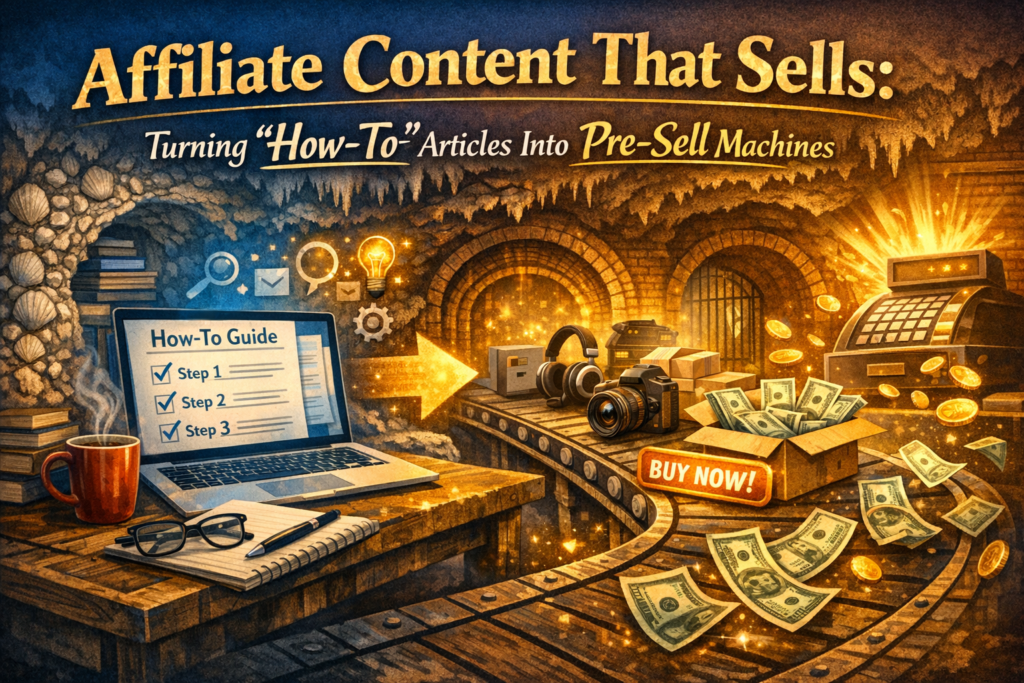
Most affiliates massively underestimate their “how‑to” content.
They treat tutorials and how‑to articles as “value posts” and reviews as “money posts,” then wonder why their audience loves their content but rarely buys.
Here’s the shift I want you to make:
Your how‑to content isn’t just educational. Done right, it’s a pre‑sell machine.
In other words, every time you teach someone how to do something, you can also (subtly and ethically) show them what to use and why your recommended tools or products are the smart choice.
In this article, I’ll show you how to turn your how‑to articles into affiliate content that sells — without feeling salesy, spammy, or manipulative. This is exactly how I’ve used tutorials for years to build trust and drive consistent commissions across different niches.
Why “How‑To” Content Is So Powerful for Affiliates
Let’s start with why this matters.
When someone searches for “how to [do something],” they’re telling you three things:
- They have a specific problem.
- They’re open to guidance and solutions.
- They’re willing to take action right now.
That’s the perfect moment to introduce the right tool, service, or product.
Compare that to someone reading a generic “top 10” list:
- They might be researching casually.
- They may not be ready to implement anything.
- They’re often comparing options without urgency.
“How‑to” readers are builders. They want to do.
Your job is to show them how to do it and what to do it with.
When you combine those two, your how‑to posts stop being “just content” and start becoming quiet, reliable sales assets.
The Big Mistake: Teaching in a Vacuum
Here’s what most affiliates do wrong with tutorials:
- They teach a process that’s totally tool‑agnostic.
- They show people 3–5 different ways to do something “with whatever you like.”
- They mention products only at the very end in a weak, tacked‑on sentence.
Result?
Great content. Grateful readers.
Almost no clicks.
The fix is simple: you anchor your entire tutorial around the product(s) you want to pre‑sell — not by forcing it, but by showing why it makes the process faster, easier, or more effective.
You’re still genuinely teaching. You’re just doing it in a way that naturally leads to:
“If you’re going to do this anyway, here’s the smartest way to do it.”
Step 1: Start With the Outcome, Not the Tool
Before you even write, ask:
- What outcome does my reader actually want here?
- What’s the painful problem they’re trying to solve?
- How does my recommended tool/product make that outcome easier?
For example:
- Outcome: “Build a simple landing page to capture leads.”
- Problem: Confused by tech, wasting hours on design.
- Product: A landing page builder that gives templates and simple customization.
Your tutorial becomes:
“How to Build a Simple Lead Generation Landing Page in 30 Minutes (Even If You Hate Tech)”
Notice we’re selling the outcome (a working landing page in 30 minutes) and using the tool as the engine to get there.
Your audience doesn’t wake up wanting to “use Tool X.”
They wake up wanting a solved problem.
Frame your how‑to around that.
Step 2: Introduce the Tool Early (But Naturally)
One of the simplest changes you can make: stop hiding your affiliate recommendation until the end.
Early in the article, right after you define the goal and who it’s for, add something like:
“In this walkthrough, I’m going to show you exactly how I do this using [Tool Name]. It’s what I use for my own [emails/landing pages/workouts/etc.] because it’s simple, fast, and beginner‑friendly. You can grab a free trial here if you want to follow along: [affiliate link].”
This does three things:
- Sets the expectation that this tutorial is based on a real setup you use.
- Gives them a chance to sign up or log in before you start the step‑by‑step.
- Plants the tool in their mind as the default way to get the result.
You’re not forcing them. You’re inviting them to follow along with what’s already working for you.
Step 3: Structure the Tutorial as a Journey, Not Just Steps
A lot of how‑to content reads like documentation: dry, technical, and forgettable.
You want your tutorial to read like a guided journey.
Use this structure:
- Context & Promise
- Who this is for
- What they’ll have by the end
- Any requirements (time, budget, tool)
- Setup With the Tool
- Sign up or log in
- Quick orientation (“here’s the dashboard, here’s what we’ll use”)
- Your affiliate link positioned as the starting point
- Main Steps
- 3–7 clear steps
- Screenshots or at least descriptive sub‑headings
- Short explanations of why you’re doing each step
- Optimization / Pro Tips
- How to avoid common mistakes
- Shortcuts you use yourself
- Advanced options they can try later
- Wrap‑Up & Next Step
- Restate the outcome
- Remind them what the tool just helped them achieve
- Give them a natural next action (publish, share, automate, etc.)
- Re‑link your affiliate offer for those who haven’t signed up yet
You’re not just handing them instructions. You’re walking beside them, which builds a ton of trust.
Step 4: Highlight the Product’s Advantages at Key Moments
Here’s where the “pre‑selling” really happens.
At certain steps, briefly point out how the tool you’re using:
- Saves time
- Prevents mistakes
- Adds extra benefits they might not know about
Examples:
- “The reason I use [Tool] instead of a generic spreadsheet is that it automatically tracks [X], which saves me at least an hour a week.”
- “You can code this manually, but using [Tool] means you don’t have to touch code at all, which is why I recommend it for beginners.”
- “This is where [Tool] is worth the money for me — you can A/B test this step without setting up anything complicated.”
Keep these comments short, honest, and grounded in your actual experience. No hype. Just “this is why I like this.”
These little moments turn your how‑to from “I learned something” into “I should probably just use what they’re using.”
Step 5: Make Your Calls to Action Specific and Embedded
Instead of one lonely button at the end, use embedded CTAs throughout the tutorial, like:
- “If you haven’t created your [Tool] account yet, do that now so you can follow along: [affiliate link].”
- “Click here to grab the same template I’m using in this walkthrough: [affiliate link].”
- “I’m using the [Plan Name] plan, which gives you [key features]. You can start with it here: [affiliate link].”
You’re matching the CTA to the exact step they’re on, so it feels helpful and logical — not random.
Still end with a clear final CTA, but don’t rely on that alone. Most people will decide mid‑way through the tutorial that they want to try what you’re using.
Step 6: Add “Proof” Around Your How‑To Articles
To really turn your tutorials into pre‑sell machines, surround them with proof content:
- Link from the tutorial to a case study where you show results using the tool.
- Mention in passing how long you’ve used it and for what.
- Sprinkle in tiny details only a real user would know (quirks, favourite features, limitations).
You can also reverse the flow:
- In a results post (“How I did X”), link back to the tutorial as “the exact steps I followed.”
- In a review post, link to the tutorial as “watch me actually use it here.”
The more connections between “this person uses it” and “this tool is part of the results,” the more naturally people accept your recommendation.
Step 7: Test and Tweak Based on Behaviour, Not Just Traffic
Your “how‑to” pre‑sell content gets more powerful as you refine it.
Look at:
- Time on page – are people staying long enough to follow the steps?
- Scroll depth – do they reach your key CTAs, or drop off early?
- Click‑through rate on affiliate links – are your embedded CTAs working?
Then adjust:
- If people drop early, tighten the intro and get into the steps faster.
- If CTAs aren’t getting clicks, move them slightly earlier or make the benefit clearer.
- If a particular step confuses people (based on comments or messages), rewrite it more clearly or add an extra screenshot/example.
Your goal isn’t to publish once and hope. It’s to turn that tutorial into a high‑converting asset you can rely on.
Simple Outline You Can Reuse for Any How‑To Pre‑Sell Article
Here’s a plug‑and‑play outline you can copy into your next article:
- Headline focused on outcome and simplicity
- Short intro: problem + promise
- “What we’ll use” section (introduce your tool and link)
- Step 1: [Action] – why it matters + how to do it with the tool
- Step 2: [Action] – same pattern
- Step 3–5: continue steps, embedding short product benefits
- Quick optimisation tips (extra value)
- Recap: what they’ve achieved + how the tool helped
- Final CTA to start or upgrade with your affiliate link
- Optional: link to a case study or review for readers who want more detail
Build a few of these around your key offers and you’ll have an entire mini‑ecosystem of content that teaches, pre‑sells, and converts.
Final Thought: Teach Like a Coach, Recommend Like a Friend
The best affiliate content that sells doesn’t feel like selling.
It feels like:
- A coach showing you the fastest way to get a result.
- A friend saying, “If you’re going to do this anyway, this is what I’d use.”
- A guide walking the path with you, not just pointing at a tool from a distance.
That’s exactly what a good “how‑to” pre‑sell article does.
You’re not tricking anyone.
You’re helping them do what they already want to do — faster, easier, and with fewer mistakes — by recommending the tools you trust.
Do that consistently, and your how‑to content becomes some of the most profitable content you’ll ever publish.
Next Step
If you want help turning your existing tutorials into pre‑sell machines — or you’d like feedback on a draft before you publish it — join The Strategic Affiliate Lab Community. Share your article, and I’ll help you tweak the structure, CTAs, and angle so it teaches brilliantly and sells ethically.