

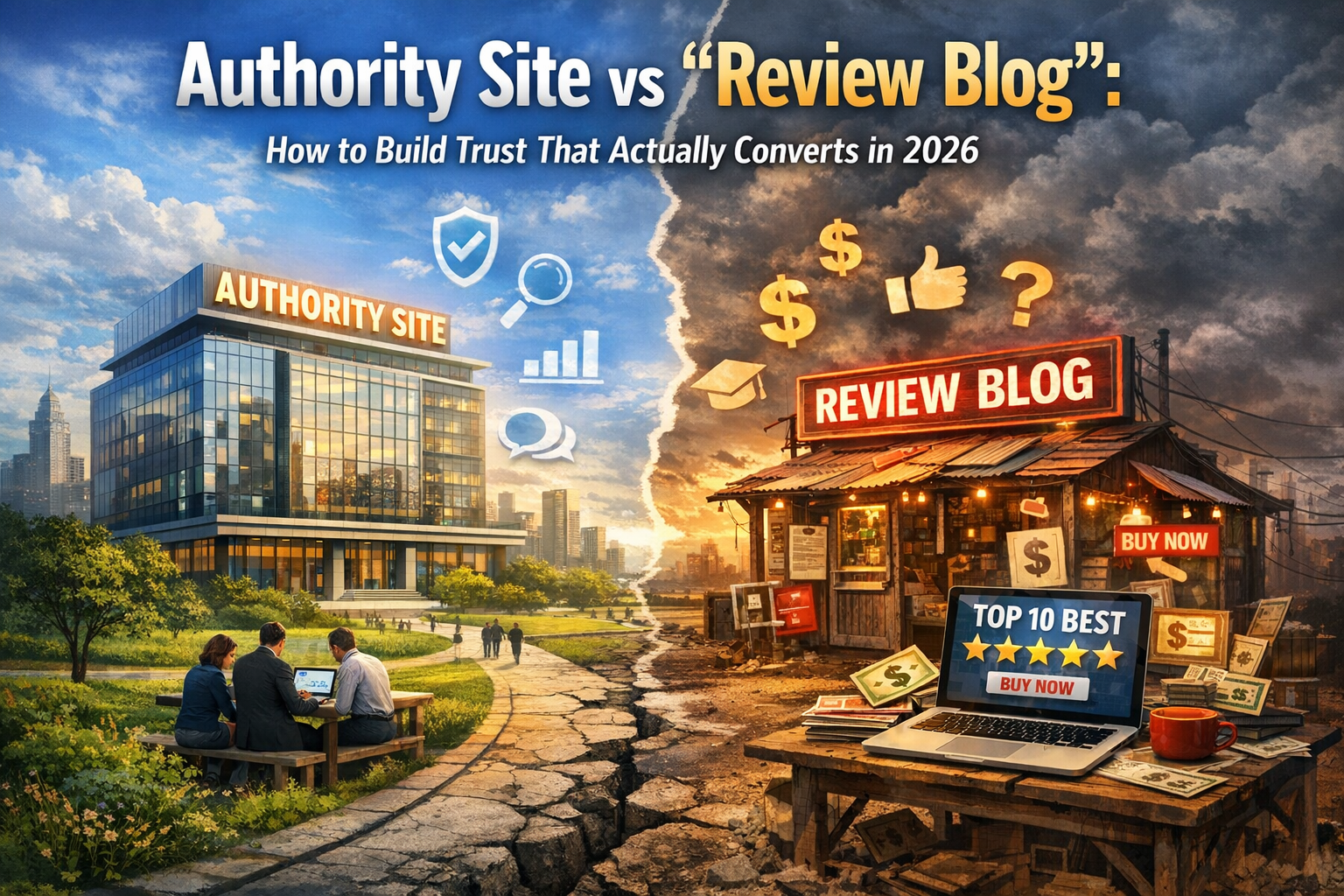
Authority Site vs Review Blog: How to Build Trust That Actually Converts in 2026
If you’ve been around affiliate marketing for more than five minutes, you’ve heard people throw around phrases like “niche site,” “review blog,” and “authority site” like they’re all the same thing.
In 2026, that difference really matters.
Because here’s what I’m seeing after nearly 19 years in this game:
- “Thin” review blogs are struggling to rank.
- Shallow “best X in 2023, 2024, 2025, 2026” content is getting ignored.
- Google and real humans are both asking the same question:
Can I actually trust this person?
Today, I want to cut through the jargon and show you the practical difference between an authority site and a basic review blog — and more importantly, how to build trust that actually converts into affiliate income this year.
What Most People Mean by “Review Blog”
Let’s start with the thing most people accidentally build.
A typical “review blog” looks like this:
- Random product reviews across a loose niche
- Lots of “best X for Y” posts
- Very little personal insight or experience
- No clear mission other than “please click my links”
It’s built around products, not people.
The reader could be anyone. The writer could be anyone.
Review blogs usually:
- Chase keywords instead of a clear audience
- Over‑rely on generic pros/cons lists
- Sound like they were written by someone who’s never touched the product
Can they still make money? Sure, sometimes. Especially if you’re early, or in a very specific micro‑niche.
But long term? They struggle because:
- They’re easy to copy.
- They don’t build loyalty.
- They don’t give people a reason to come back.
In a world where AI can churn out “10 Best X in 2026” posts all day, a thin review blog is a race to the bottom.
What an Authority Site Really Is (In Practical Terms)
People hear “authority site” and imagine some giant content machine with 500 posts and a team of writers.
That’s not what I mean.
An authority site is simply:
A site that solves real problems for a specific audience, over and over again, in a way that builds trust and recognition.
A few key traits:
- It speaks to a clear type of person (not “everyone on the internet”).
- It has a point of view, not just generic information.
- It offers a mix of content: education, reviews, comparisons, opinions, and stories.
- It looks and feels like it’s run by a real human being with real experience.
An authority site is built around a mission, not just commission:
- “Helping creators turn content into income.”
- “Helping dads over 40 get in shape without a gym.”
- “Helping local business owners get their first 100 customers online.”
Products are still promoted. But they’re just tools inside a bigger journey.
Why Authority Matters More Than Ever in 2026
The internet has changed a lot since I wrote my first affiliate article in 2007.
Three big shifts:
- Algorithms now reward expertise and experience.
Search engines look for real signals of authority: author profiles, depth of content, consistency, external mentions, and user behaviour (do people come back, read more, stick around?). - Audiences are sceptical and tired of hype.
They’ve clicked fake reviews. They’ve fallen for shiny offers. They’ve been burned by bad recommendations. Most people can smell a “made for commissions only” site in seconds. - Competition has increased — but so has opportunity.
Yes, there are more creators. But there are also more buyers, more niches, more tools, and more ways to build trust. The people who win in 2026 are the ones who lean into trust, not play it down.
When you build an authority site instead of a shallow review blog:
- People remember your name.
- They share your content.
- They join your email list.
- They buy from your links more than once.
You stop chasing one‑off clicks and start building a real asset.
Authority Site vs Review Blog: Key Differences
Here’s a simple way to look at it:
| Aspect | Review Blog | Authority Site |
|---|---|---|
| Focus | Products | People (specific audience) |
| Voice | Generic, “anyone could write this” | Personal, opinionated, experience‑based |
| Content types | Mostly reviews and “best of” lists | Reviews, tutorials, stories, case studies, opinions |
| Goal | Get clicks quickly | Build trust, then get clicks repeatedly |
| Relationship | Anonymous visitors | Returning readers/subscribers |
| Time horizon | Short‑term rankings | Long‑term brand and income |
The punchline:
- A review blog asks, “How do I rank for this keyword?”
- An authority site asks, “How do I help this person solve this problem, and what’s the best product to recommend along the way?”
That one shift changes everything.
How to Turn a “Review Blog” Into an Authority Site
You don’t need to throw away your existing site and start again. You can evolve what you’ve got.
Here’s how.
1. Decide who your site is really for
Not “anyone who wants to make money online.”
Get specific.
Examples:
- “Beginners who want their first affiliate commission in 30–90 days.”
- “Busy professionals who want to get lean with 20‑minute home workouts.”
- “Solo business owners who want simple marketing systems, not complexity.”
Write a one‑sentence statement and put it somewhere visible when you create content.
2. Add your story and your stance
Authority isn’t just about knowledge. It’s about point of view.
Ask:
- Why do you care about this topic?
- What mistakes have you made that your audience can avoid?
- What do you believe that’s different from the usual advice?
Create:
- A clear “About” page that shares your backstory and mission.
- A short “Start here” page that tells new visitors what to read first.
This alone moves you miles away from a faceless review blog.
3. Balance reviews with helpful “non‑review” content
Instead of only writing “best X” and “[tool] review” posts, add:
- Tutorials (“How to do X using Y”)
- Strategy posts (“The 3 things beginners should focus on first”)
- Case studies (“How I used this tool to achieve [specific result]”)
- Opinion pieces (“Why I stopped promoting [type of product]”)
Now your affiliate recommendations sit inside a context your readers trust.
4. Show your work (and your receipts)
One of the biggest trust‑builders in 2026: proof.
That doesn’t mean claiming crazy results. It means:
- Screenshots (with context).
- Step‑by‑step walkthroughs of what you did.
- Honest “this worked, this didn’t” breakdowns.
Even if your results are modest, they’re real. People connect with that far more than polished, unbelievable claims.
Practical Content Plan: Authority‑Driven Posts That Still Sell
Let’s make this concrete. If you want to build an authority site that converts, aim to mix your content like this over the next 60–90 days:
- 3–5 in‑depth product reviews (from experience, not specs alone)
- 3–5 comparisons (“Tool A vs Tool B for [specific person]”)
- 4–6 tutorials that solve common problems in your niche
- 2–4 case studies or “what I learned doing X” posts
- 2–3 opinion/strategy pieces that show your perspective
You can still include “best X for Y” posts, but they shouldn’t be all you do. They’re just one part of the ecosystem.
Think of your site like this:
- Reviews and comparisons = conversion content
- Tutorials and case studies = trust content
- Opinion/strategy = authority content
When you have all three, you’re no longer just a review blog. You’re a go‑to resource.
How Authority Translates Into Actual Conversions
Let’s talk money for a second.
Why does all this “authority” stuff matter if you just want to make sales?
Because people:
- Click more of your links over time.
- Are more willing to buy at higher price points.
- Are more likely to buy again from your recommendations.
- Are more likely to join your list or community, where you can help them longer.
Here’s what I’ve seen again and again:
- A thin review site might get a flurry of commissions, then fade.
- An authority site with fewer visitors can often make more because trust is higher and conversion rates are better.
Instead of constantly hunting for new people, you build a base of readers who actively want to know what you recommend next.
That’s when affiliate marketing stops feeling like a grind and starts feeling like a real business.
What to Focus On for the Rest of 2026
If you take nothing else from this article, take this:
In 2026, trust is the real algorithm.
To build it:
- Be clear about who you help and how.
- Share your experiences, not just your links.
- Mix educational, story‑driven, and review content.
- Only promote offers you’re proud to stand behind.
- Think long‑term: build a name, not just a niche site.
You don’t have to be the biggest site in your niche.
You just have to be the one people actually believe.
That’s what an authority site is.
And that’s why it beats a generic review blog every single time.
Next Step
If you want help turning your existing “review‑style” site into a true authority site that builds trust and conversions, join The Strategic Affiliate Lab Community. That’s where we break down your niche, your content plan, and your offers — and rebuild them into a focused, trust‑driven system you can grow all year.